When building complex analytic solutions you need to consider the type of platform that best suits the data you want to analyze and the hypothesis for analyzing it. These can be used interchangeably; the hypothesis can come first and the data second, but these two issues must be addressed. This post will provide a quick synopsis on (1) why the Ikanow Enterprise Edition was built on top of MongoDB, (2) an illustration of the differences between the two technologies, and (3) the reasons behind the selection of MongoDB as the underlying analytics data repository for the Ikanow analytics platform.
MongoDB & Ikanow: The Perfect Match
MongoDB, for those that are in the IT space, is a non-relational NoSQL database environment that scales extremely well. Scaling extremely well means it can go across many nodes of computers and provide very near linear scalability in a very reliable way. Ikanow built our Enterprise and Community Edition analytics platforms with similar principles to MongoDB but with an analytics focus. We took the best of MongoDB as a platform and then built tools and capabilities on top of it. So it’s not necessarily about the differences between the two platforms as it is expanding on something and making it easier to use for a specific business need.
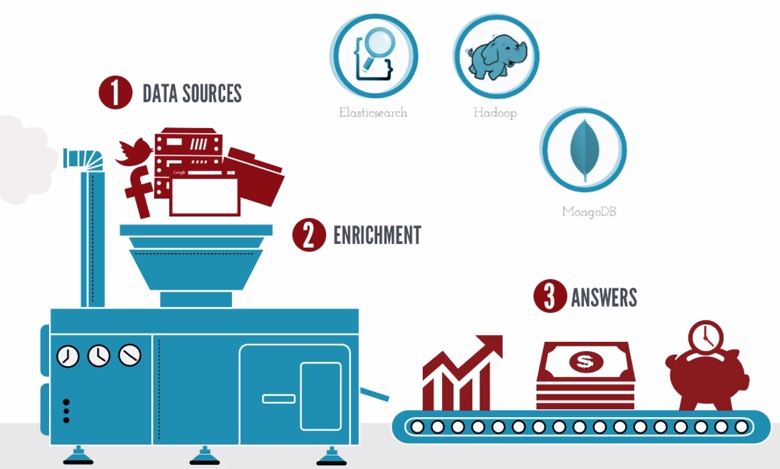
The MongoDB database environment offers robust community support and is easy to develop on. The platform actually makes our job at Ikanow easier because we know that the MongoDB guys are producing a great product, they’re effectively dealing with any issues that arise, and they’re supporting their customer base extremely well.
Our trust in the MongoDB technology means we can focus on creating enabling tools on top of the platform to readily enable businesses to perform analytic functions. Our focus is to help organizations perform complex analytics in an easier way. In order to do that, we had to have a way to store, process, and analyze information. This is where MongoDB comes into the process. Every record processed by the Ikanow platform eventually finds its way into a MongoDB collection. We have also analytical layers and tools on top of that platform to enable analytic functions. This way we get to leverage the community support and innovation by taking the product forward allowing us to focus on creating meaningful tools that make it easier to do analytics in that platform.
An Example of how Ikanow uses MongoDB
For example, once we harvest information from its specific data source, that information has a specific ontology that is extracted and that information is placed into the MongoDB platform. From there, we have tools and techniques that allow the end user to pull out that information and run custom analytic jobs against it by making it easier to get the information.
By taking advantage of the MongoDB platform, Ikanow users have an enterprise database platform backing the Ikanow enterprise edition. If they’re already using MongoDB to take advantage of existing infrastructure to launch a full scale analytics platform, it reduces the barrier for entry for that solution and reduces the total cost of ownership of an analytics platform.
If your organization has the need to analyze large volumes of documents that are different in structure, for instance, you need to access social media information or you need to access open internet related information from blogs and forums or you need to access more structured information behind a firewall, the pairing of MongoDB and the Ikanow Enterprise Edition makes a lot of sense for organizations due to the flexible nature of our schema.
This allows us to produce semi-structured data schemas that lend themselves to a fusion of those two types of data, on top of a JSON representation, which is great for semi-structured information. If your organization has already made an investment in MongoDB and is looking to stand up an analytics platform, the legwork has already been done by Ikanow. We put blood, sweat, and tears into building up a foundational structure on top that marries the two solutions extremely well together from an integration standpoint. Organizations can be confident that they’re getting a toolset that will function in a way that is designed to work specifically with that platform.
Start Analyzing Today
If your organization is just beginning to look into standing up an analytics platform, it’s extremely easy to use these two tools because of they’re both open source technologies. You can simply go on to the web, download the Ikanow Community Edition, download the MongoDB open source platform, and be up and running with a zero cost impact to your business and can test the waters to make sure it’s right for you.
If you’ve not started using an analyzing technology, we would love to hear from you and help you start to diagnose specifically against the problems you’re facing. If your problem is not in our niche area, we’ll definitely let you know that and point you in the right direction. If it is, we’d be happy to help you analyze it.
Interested in receiving quarterly newsletters from IKANOW?

Learn more from IKANOW:
Visit the Resource Center

MongoDB and Ikanow: How they work together to provide an open analysis platform for best results
When building complex analytic solutions you need to consider the type of platform that best suits the data you want to analyze and the hypothesis for analyzing it. These can be used interchangeably; the hypothesis can come first and the data second, but these two issues must be addressed. This post will provide a quick synopsis on (1) why the Ikanow Enterprise Edition was built on top of MongoDB, (2) an illustration of the differences between the two technologies, and (3) the reasons behind the selection of MongoDB as the underlying analytics data repository for the Ikanow analytics platform.
MongoDB & Ikanow: The Perfect Match
MongoDB, for those that are in the IT space, is a non-relational NoSQL database environment that scales extremely well. Scaling extremely well means it can go across many nodes of computers and provide very near linear scalability in a very reliable way. Ikanow built our Enterprise and Community Edition analytics platforms with similar principles to MongoDB but with an analytics focus. We took the best of MongoDB as a platform and then built tools and capabilities on top of it. So it’s not necessarily about the differences between the two platforms as it is expanding on something and making it easier to use for a specific business need.
The MongoDB database environment offers robust community support and is easy to develop on. The platform actually makes our job at Ikanow easier because we know that the MongoDB guys are producing a great product, they’re effectively dealing with any issues that arise, and they’re supporting their customer base extremely well.
Our trust in the MongoDB technology means we can focus on creating enabling tools on top of the platform to readily enable businesses to perform analytic functions. Our focus is to help organizations perform complex analytics in an easier way. In order to do that, we had to have a way to store, process, and analyze information. This is where MongoDB comes into the process. Every record processed by the Ikanow platform eventually finds its way into a MongoDB collection. We have also analytical layers and tools on top of that platform to enable analytic functions. This way we get to leverage the community support and innovation by taking the product forward allowing us to focus on creating meaningful tools that make it easier to do analytics in that platform.
An Example of how Ikanow uses MongoDB
For example, once we harvest information from its specific data source, that information has a specific ontology that is extracted and that information is placed into the MongoDB platform. From there, we have tools and techniques that allow the end user to pull out that information and run custom analytic jobs against it by making it easier to get the information.
By taking advantage of the MongoDB platform, Ikanow users have an enterprise database platform backing the Ikanow enterprise edition. If they’re already using MongoDB to take advantage of existing infrastructure to launch a full scale analytics platform, it reduces the barrier for entry for that solution and reduces the total cost of ownership of an analytics platform.
This allows us to produce semi-structured data schemas that lend themselves to a fusion of those two types of data, on top of a JSON representation, which is great for semi-structured information. If your organization has already made an investment in MongoDB and is looking to stand up an analytics platform, the legwork has already been done by Ikanow. We put blood, sweat, and tears into building up a foundational structure on top that marries the two solutions extremely well together from an integration standpoint. Organizations can be confident that they’re getting a toolset that will function in a way that is designed to work specifically with that platform.
Start Analyzing Today
If your organization is just beginning to look into standing up an analytics platform, it’s extremely easy to use these two tools because of they’re both open source technologies. You can simply go on to the web, download the Ikanow Community Edition, download the MongoDB open source platform, and be up and running with a zero cost impact to your business and can test the waters to make sure it’s right for you.
If you’ve not started using an analyzing technology, we would love to hear from you and help you start to diagnose specifically against the problems you’re facing. If your problem is not in our niche area, we’ll definitely let you know that and point you in the right direction. If it is, we’d be happy to help you analyze it.
Interested in receiving quarterly newsletters from IKANOW?
Learn more from IKANOW:
Visit the Resource Center